
The Search for the Anti Aging Pill Reading Answers with Explanations
Are you an IELTS candidate looking for a free and helpful reading passage to ace the reading section? If yes, solve the search for the anti aging pill reading answers for practice. It will make your practice more effective and also help you boost your skimming and scanning capabilities. This part of the exam assesses students' English language skills with 4-5 types of questions. Thus, you have to solve 3 passages in 60 minutes. So, try to solve this write-up in approx 20 minutes to manage your time in the exam. Try to get all the solutions correct within the timeline.
But if you are facing difficulties you can prepare for the exam with Gradding.com free IELTS mock test.
IELTS Prep Boost
Elevate your preparation with exclusive tools
Unlimited Access Includes
BEST PLANDuration Days
IELTS Reading Passage- The Search For The Anti Aging Pill
“In government laboratories and elsewhere, scientists are seeking a drug able to prolong life and youthful vigor. Studies of caloric restriction are showing the way”
Paragraph- A
As researchers on aging noted recently, no treatment on the market today has been proven to slow human aging - the build-up of molecular and cellular damage that increases vulnerability to infirmity as we grow older. But one intervention, consumption of a low-calorie* yet nutritionally balanced diet, works incredibly well in a broad range of animals, increasing longevity and prolonging good health. Those findings suggest that caloric restriction could delay aging and increase longevity in humans, too.
Paragraph-B
Unfortunately, for maximum benefit, people would probably have to reduce their caloric intake by roughly thirty percent, equivalent to dropping from 2,500 calories a day to 1,750. Few mortals could stick to that harsh regimen, especially for years on end. But what if someone could create a pill that mimicked the physiological effects of eating less without actually forcing people to eat less? Could such a ‘caloric restriction mimetic’, as we call it, enable people to stay healthy longer, postponing age-related disorders (such as diabetes, arteriosclerosis, heart disease, and cancer) until very late in life? Scientists first posed this question in the mid-1990s, after researchers came upon a chemical agent that in rodents seemed to reproduce many of caloric restriction’s benefits. No compound that would safely achieve the same feat in people has been found yet, but the search has been informative and has fanned the hope that caloric restriction (CR) mimetics can indeed be developed eventually.
Paragraph- C: The benefits of caloric restriction
The hunt for CR mimetics grew out of a desire to better understand caloric restriction’s many effects on the body. Scientists first recognized the value of the practice more than 60 years ago, when they found that rats fed a low-calorie diet lived longer on average than free-feeding rats and also had a reduced incidence of conditions that become increasingly common in old age. What is more, some of the treated animals survived longer than the oldest living animals in the control group, which means that the maximum lifespan (the oldest attainable age), not merely the normal lifespan, increased. Various interventions, such as infection-fighting drugs, can increase a population’s average survival time, but only approaches that slow the body’s rate of aging will increase the maximum lifespan.
Paragraph- D
The rat findings have been replicated many times and extended to creatures ranging from yeast to fruit flies, worms, fish, spiders, mice, and hamsters. Until fairly recently, the studies were limited to short-lived creatures genetically distant from humans. But caloric-restriction projects underway in two species more closely related to humans - rhesus and squirrel monkeys - have made scientists optimistic that CR mimetics could help people.
Paragraph- E
The monkey projects demonstrate that, compared with control animals that eat normally, caloric-restricted monkeys have lower body temperatures and levels of the pancreatic hormone insulin, and they retain more youthful levels of certain hormones that tend to fall with age.
Paragraph- F
The caloric-restricted animals also look better on indicators of risk for age-related diseases. For example, they have lower blood pressure and triglyceride levels (signifying a decreased likelihood of heart disease), and they have more normal blood glucose levels (pointing to a reduced risk for diabetes, which is marked by unusually high blood glucose levels). Further, it has recently been shown that rhesus monkeys kept on caloric-restricted diets for an extended time (nearly 15 years) have less chronic disease. They and the other monkeys must be followed still longer, however, to know whether low-calorie intake can increase both average and maximum lifespans in monkeys. Unlike the multitude of elixirs being touted as the latest anti-aging cure, CR mimetics would alter fundamental processes that underlie aging. We aim to develop compounds that fool cells into activating maintenance and repair.
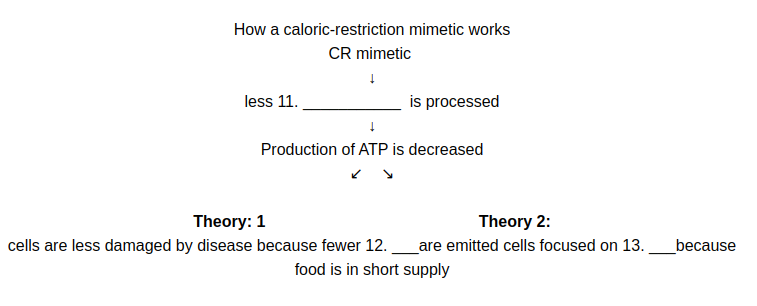
Paragraph- G: How a prototype caloric-restriction mimetic works
The best-studied candidate for a caloric-restriction mimetic, 2DG (2-deoxy-D-glucose), works by interfering with the way cells process glucose. It has proved toxic at some doses in animals and so cannot be used in humans. But it has demonstrated that chemicals can replicate the effects of caloric restriction; the trick is finding the right one.
Paragraph- H
Cells use the glucose from food to generate ATP (adenosine triphosphate), the molecule that powers many activities in the body. By limiting food intake, caloric restriction minimizes the amount of glucose entering cells and decreases ATP generation. When 2DG is administered to animals that eat normally, glucose reaches cells in abundance but the drug prevents most of it from being processed and thus reduces ATP synthesis. Researchers have proposed several explanations for why interruption of glucose processing and ATP production might retard aging. One possibility relates to the ATP-making machinery’s emission of free radicals, which are thought to contribute to aging and to such age-related diseases as cancer by damaging cells. Reduced operation of the machinery should limit their production and thereby constrain the damage. Another hypothesis suggests that decreased processing of glucose could indicate to cells that food is scarce (even if it isn't) and induce them to shift into an anti-aging mode that emphasizes the preservation of the organism over such ‘luxuries' as growth and reproduction.
Questions for Reading Passage: The Search For The Anti Aging Pill
Questions 1-5
Do the following statements agree with the claims of the writer in Reading Passage?
In boxes 1-5 on your answer sheet, write
YES if the statement agrees with the claims of the writer
NO if the statement contradicts the claims of the writer
NOT GIVEN if it is impossible to say what the writer thinks about this
1. Studies show drugs available today can delay the process of growing old.
2. There is scientific evidence that eating fewer calories may extend human life.
3. Not many people are likely to find a caloric-restricted diet attractive.
4. Diet-related diseases are common in older people.
5. In experiments, rats who ate what they wanted led shorter lives than rats on a low-calorie diet.
Questions 6-10
Classify the following descriptions as relating to
A caloric-restricted monkeys
B control monkeys
C neither caloric-restricted monkeys nor control monkeys
6. Monkeys were less likely to become diabetic.
7. Monkeys experienced more chronic disease.
8. Monkeys have been shown to experience a longer than average life span.
9. Monkeys enjoyed a reduced chance of heart disease.
10. Monkeys produced greater quantities of insulin.
Questions 11-13
Complete the flow-chart below.
Choose NO MORE THAN TWO WORDS from the passage for each answer.
Premium IELTS Coaching
at an Affordable Price
Answer of the Search for the Anti Aging Pill Reading Passage with Explanation
Let us learn the explanation of the search for the anti aging pill reading answers. By reading below you will get to know the reasons for mentioned solutions.
Question 1
Question 2
Question 3

Unlock All Explanations for Free
Question 4
Question 5
Question 6
Question 7
Question 8
Question 9
Question 10
Question 11
Question 12
Question 13

IELTS Prep Boost
Unlimited Access Includes
Other Passages
Important Links for IELTS Exam
Explore Free IELTS Mock Tests
Find IELTS Coaching Centres
Practice Every IELTS Module
Essential IELTS Tools & Resources
Study Abroad Consultants in India
Top Study Abroad Destinations
Exams Required to Study Abroad
Popular Universities to Study Abroad
Important Links for IELTS Exam
Explore Free IELTS Mock Tests
Find IELTS Coaching Centres
Practice Every IELTS Module
Essential IELTS Tools & Resources
Study Abroad Consultants in India
Top Study Abroad Destinations
Popular Universities to Study Abroad
Quick Links
The above reading passage is a research study on aging that has been recently shown in humans. Moreover, the search for the anti-aging pill reading answers will help you better understand the pattern and 3 types of questions in the IELTS reading section. By practicing the IELTS reading mock test provided by Gradding.com, you will also improve your vocabulary and comprehension skills.
Tips to Ace the Reading Passage On “ The Search For The Anti Aging Pill”
Below are a few strategies for each question type to help you easily solve the search for the anti-aging pill reading answers with ease.
- True/ False/Not Given: The question can be difficult. If you are unsure of an answer, try paraphrasing it in different words.
- Matching Features: Review all matches to ensure they are coherent and aligned with the criteria.
- Flow Chart Completion: Look for keywords or synonyms in the write-up that match the information needed for every gap.
Types of Questions in this Reading Passage
To solve the search for the anti aging pill reading answers, you should understand the three types of questions. So, let us discuss to know each of them in detail.
True/ False/Not Given
In this type of question, determine whether the statements provided agree with contradict or are not mentioned in the reading passage.
Tips to make your answer best:
- Understand the details being presented and what is being asked.
- Find suitable data in the reading passage that relates to the statement.
- Determine if the statement agrees to contradict or is not mentioned in the passage.
- If the information is not explicitly provided in the passage, select “Not Given” rather than making assumptions.
- Base your answers solely on the data presented in the write-up, avoiding personal opinions or outside knowledge.
Matching Features
In this type of question, you match a list of opinions with the correct individual from a provided list. This type of query checks your ability to identify connections between people and their contributions or viewpoints mentioned in the text.
Tips to make your answer best:
- Carefully read the guidelines to know what criteria or basis for matching.
- Identify the key features of each item on the list.
- Use the elimination process to check the options for the remaining matches.
- Review all matches to ensure they are coherent and aligned with the criteria.
- Look for connections between items to enhance the efficiency of making correct matches.
Flow Chart Completion
In this type of question, fill in the blanks with specifics described in the passage. The given details might relate to a process, sequence of events, steps in procedure or stages in development.
Tips to make your answer best:
- Pay close attention to the flowchart or diagram and the provided instructions.
- Quickly scan the relevant sections of the passage to gather data that fit the gaps in the flowchart.
- Ensure that the information you choose accurately fits the context of the flowchart or diagram.
- Look for keywords or synonyms in the passage to match the data needed for each gap.
- Ensure your answers are grammatically correct and fit within the given word limit.
Preparing for the IELTS reading section often requires a knowledge of the different types of queries that come with the tasks. The above-given search for the anti-aging pill reading passage provided a detailed explanation to help you improve your skimming and scanning skills for the reading section.
Apart from this, if you want to get proper classes to get the best band score in IELTS enroll in Gradding.com online IELTS coaching. Here, experts provide free mock tests, live classes by top-notch teaching faculty, and so on.
